


The Spectacle of Politics: Why Are We Drawn to the Arena?
Last night, a UFC cage fight was held on the South Lawn of the White House.
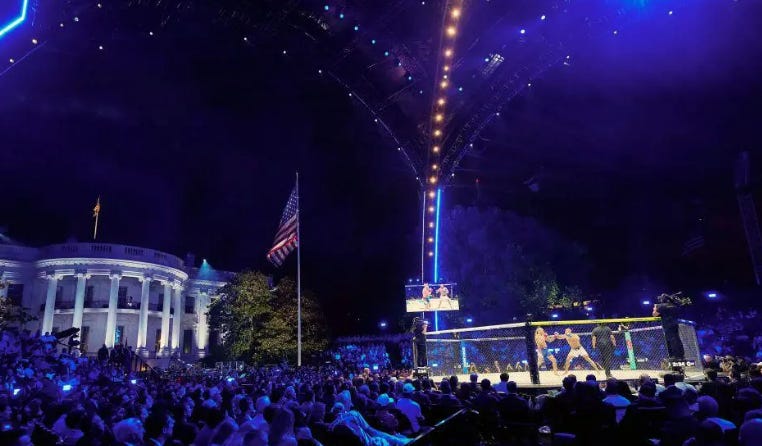
That is certainly not a sentence I ever anticipated writing five years ago. Or even two.
It feels absurd and inevitable at the same time. Like when you start to say, “I can’t believe...” and then correct yourself halfway through the sentence because, actually, you totally can.
Over the past few weeks, the world has watched photographs of the arena gradually taking shape in the heart of American political power. A giant cage. Amphitheatre-style seating. Floodlights. A stage designed for violent combat.
I’ve found myself vaguely troubled (and oddly fascinated) by it.
Not because I’m particularly interested in mixed martial arts. Nor because the current US administration still possesses the power to surprise me. That particular threshold was crossed some time ago.
No, I think it was something else.
The more I looked at the photographs, the more they seemed strangely familiar.
Not the cage itself. Not even the architecture.
The symbolism. The combination of political power, public spectacle and ritualised violence.
Eventually I realised what my brain had been trying to tell me.
The Colosseum.
Now before you roll your eyes and dismiss me as being a drama queen (you certainly wouldn’t be the first in that regard), I’m not suggesting that the White House is Ancient Rome or that Donald Trump is Emperor Commodus.
Yet.
Still, once the historical connection was made, I’ve found it difficult to shake.
So I went deeper.
Despite studying Classical Civilisations at school and college, I carry around a fairly simplified understanding of the Roman gladiatorial games. Bread and circuses. Cynical elites distracting the population from their poverty and political grievances with free food and entertainment while they got on with running the empire.
And there is certainly truth in that.
The games projected power. Reinforced social hierarchies. Celebrated military virtues. Demonstrated Rome’s reach and wealth. They served political purposes.
But that isn’t the whole story.
Because the games also became enormously popular. Romans didn’t merely tolerate them. They loved them.
They followed gladiators with the same enthusiasm modern audiences follow athletes, football teams and celebrities. They travelled vast distances to attend. They debated outcomes, chose favourites and etched images of them into the stone of the amphitheatres.
So the question that jumps out to me is this:
If the games were simply a tool of manipulation, why were they so enthusiastically embraced?
Or put another way, which came first? Did Roman leaders create the appetite for spectacle?
Or did they discover an appetite that already existed and learn how to exploit it?
My instinct is that the answer is probably both.
And perhaps that is why the comparison between then and now feels relevant.
When we talk about modern politics, there is often an assumption that spectacle is something being done to us.
Politicians manipulate. The media sensationalises. Algorithms exploit our psychology.
There is truth in all of those explanations.
But they all place us in the role of passive observers. The audience. The recipients. The people having the wool pulled over our eyes.
The Romans make me wonder whether it’s more complicated than that.
Because the arena didn’t thrive for centuries simply because emperors wanted it to. It thrived because people kept turning up.
And the more I sat with that thought, the more disturbing it became.
After all, every generation likes to believe it is less susceptible to manipulation than the one that came before. More informed. More rational. More sophisticated.
Yet the Romans almost certainly thought they were rational too.
It’s very easy to look at the crowd in the Colosseum and wonder how they could be so captivated by spectacle.
Much harder to acknowledge that we are drawn to many of the samen things.
If I’m honest, I can feel some of those instincts in myself. I complain about the flattening of political discourse. The tribalism. The certainty. The reduction of complex issues into simple stories with heroes and villains.
Yet I also understand the pull of those stories.
The attraction of certainty. The emotional satisfaction of watching your side win. The appeal of conflict over complexity.
Complexity is exhausting. Most of us spend our days navigating competing demands, incomplete information and problems that refuse to fit into neat categories.
There is therefore something undeniably appealing about a story in which the sides are obvious and the outcome is clear.
Which is perhaps why politics, at its most frustrating, asks a great deal of us.
It asks us to sit with ambiguity. To accept that people we disagree with are not necessarily stupid or evil. To acknowledge that many of society’s hardest problems involve competing interests and imperfect solutions. To tolerate outcomes that leave nobody entirely satisfied.
An arena asks rather less.
There is a winner. There is a loser. There is a side to cheer for. A side to boo.
The rules are clear. The objective is obvious. The emotional payoff is immediate.
Perhaps that is why spectacle is so enduring.
Not because humans are simpletons. But because certainty is easier than ambiguity. Tribalism is easier than curiosity. And cheering is easier than thinking.
The Romans understood that.
Which is perhaps why the games endured for centuries.
I think what troubles me about that cage on the White House lawn is not so much the UFC or the spectacle of it all.
Every society creates spectacles. The Olympics, World Cups, coronations, military parades and state funerals all serve as expressions of identity, belonging and shared values.
What keeps nagging at me is the setting.
Hosting a cage fight in Las Vegas is one thing.
Placing it at the symbolic centre of a democracy feels like something else entirely.
Symbols matter. They communicate values. And values shape culture.
What values does a nation choose to celebrate when it places a violent cage fight at the heart of a national celebration?
After all, this is not simply competition. It is a particular kind of competition. One whose purpose is not persuasion, compromise or coexistence, but domination.
What virtues are being elevated and projected to the world?
Strength? Dominance? Victory?
Now, to be fair, those qualities are not necessarily negative within the confines of sport. Courage. Endurance. Resilience. Physical excellence. Most spectators would recognise something admirable in all of those things.
But democracy is built upon a rather different set of virtues.
Compromise. Persuasion. Restraint. Coexistence. Compassion.
The ability to live alongside people we disagree with. Patience. Curiosity. The willingness to engage with complexity even when certainty would feel more emotionally satisfying.
And perhaps that is the thought I keep returning to.
Not whether politics contains spectacle. It always has.
Not even whether politicians understand the power of spectacle. The Romans understood it. Populists understand it.
Many institutional politicians, if anything, underestimate it. Some even have contempt for it.
No, the question that keeps nagging at me is slightly different.
What happens when the values rewarded in the arena begin replacing the values required for democracy?
Because arenas ask very little of us. Choose a side. Cheer. Boo. Thumbs up. Thumbs down. Go home.
Democracy asks much more.
Which is perhaps what has been bothering me about the image of the arena all along.
Not that it reminded me of Rome. Nor even that it celebrated spectacle.
Human beings have always loved spectacle. We probably always will.
It was the setting.
Sport belongs in an arena. Politics belongs in a democracy.
And while both involve competition, they require fundamentally different virtues.
One rewards victory. The other depends upon coexistence.
One seeks to defeat an opponent. The other ultimately requires us to live alongside them.
One asks us to be spectators. The other asks us to be citizens.
Perhaps that distinction sounds old-fashioned.
But looking at the South Lawn of the White House, it feels important.
Because the challenge facing democracies is not protecting ourselves from spectacle.
It is ensuring that spectacle does not become a substitute for citizenship.
And that, more than the cage itself, is what gave me pause.