


For a brief period of my life, I became convinced I might be a sociopath. Or perhaps a psychopath. I can never remember which is which.
My colleague and I were complaining about discussing our mutual boss and he casually remarked that the boss met all seven sociopath criteria, citing Confessions of a Sociopath by M.E. Thomas, which he promptly gifted me. Intrigued, I followed this up with The Psychopath Test by Jon Ronson.
This, rather unexpectedly, triggered my first (but certainly not my last) existential identity crisis.
As I worked my way through the diagnostic criteria, I discovered that one of the warning signs appeared to be observing other human beings closely.
Which I do.
Constantly.
I watch how people interact. I notice who speaks first. Who defers. Who interrupts. Who changes their position depending on who is in the room. Body language. Choice of words. Facial expressions. All of it is endlessly fascinating.
I consequently spent the next several days in a heightened state of panic. Did that mean I was on my way to becoming the next Hannibal Lecter? Is that what my colleague was trying to tell me in gifting me the book?!
Then I realised that worrying about being a sociopath was probably fairly strong evidence that I wasn’t one.
Relieved, I carried on observing people anyway.
Which brings me, rather clunkily, to populists.
I’ve often wondered why politicians like Trump, Farage, Orbán and Milei seem able to say and do things that would destroy more conventional politicians.
The standard – slightly simplistic and probably patronising – explanation is that their supporters simply don’t care.
There is, of course, a core constituency of supporters for whom their leader can do no wrong. But that doesn’t fully explain Brexit, the re-election of Trump or the broader rise of populist movements across the West.
So I’m not convinced that’s the whole story.
I think something much more interesting is happening.
I think people are responding to what feels like authenticity.
What resonates is often less agreement with everything these politicians say or do than the sense that they are unscripted. Unmanaged. Flawed.
Human.
In a world full of talking points, media training and carefully tested language, that can feel refreshing.
The problem, of course, is that authenticity and correctness are not the same thing.
Someone can be authentically wrong. Authentically ignorant. Authentically offensive. Authentically ridiculous.
Yet we seem increasingly willing to forgive flaws in people who don’t hide them, in ways we are not willing to forgive those who strike us as manufactured.
And I think we see versions of this far beyond politics.
Years ago, while working in the Foreign Office, there was a push towards encouraging people to bring their authentic selves to work.
Those of us who understood the underlying rationale largely shrugged and carried on as normal.
Others heard something quite different.
Finally.
Permission to say whatever comes into my head.
What followed was not so much a flowering of trust and connection as an enthusiastic shedding of filters. An unburdening of long-held grievances. Streams of consciousness. Observations beginning with “No offence, but...” and ending with “Stop being so sensitive.”
Looking back, I wonder if that misunderstanding wasn’t confined to the Foreign Office.
At the time, I thought it was simply one of those curious workplace phenomena: a well-intentioned message that had somehow been interpreted very differently by different people.
The longer I’ve sat with it, however, the more I wonder whether something similar has happened more broadly.
For a period, many institutions became intensely concerned with avoiding offence. In some cases, people were genuinely uncertain about what could be said, how it could be said and who might object.
The reaction to that environment was perhaps inevitable.
After all, most of us don’t enjoy feeling as though we are walking on eggshells.
But pendulums rarely stop in the middle.
And I sometimes wonder whether the current enthusiasm for radical honesty, brutal candour and “telling it like it is” is, at least in part, a reaction to what came before.
If so, it strikes me as a rather familiar misunderstanding.
Because the answer to excessive caution is not the removal of all restraint.
Just as the answer to relentless self-censorship is not relentless self-expression.
Both seem to start from the same assumption: that communication is primarily about expressing ourselves.
I’m not sure that’s true.
Most of the meaningful conversations in my life have involved another person.
Which means communication is not simply an act of self-expression. It is a relationship.
And relationships require something more complicated than either silence or unfiltered disclosure.
They require judgement.
The ability to say what needs to be said whilst remaining attentive to the person hearing it.
Not every offence can be avoided.
Not every awkward truth can be delivered perfectly.
Not every clumsy phrase is evidence of malice.
But neither, I suspect, is every passing thought entitled to an audience.
Authenticity has become one of those words that sounds universally positive until you stop and ask what it actually means.
Many people seem to interpret it as radical transparency. Saying everything. Sharing everything. Expressing every opinion. Treating every thought and feeling as worthy of being voiced simply because it happens to be theirs.
But I don’t think authenticity is the absence of filters.
Throughout my diplomatic career, people regularly told me I was unlike any British diplomat they had met.
Sometimes it was intended as a compliment. Often I suspect it wasn’t.
Either way, I took it as one.
What they were really saying was that I didn’t fit their image of someone guarded, scripted or evasive.
The irony is that I’m actually a very private person.
But what I learned early on is that openness and disclosure are not the same thing.
You can reveal enough of yourself for people to feel they know you without telling them everything.
In fact, I suspect many of our strongest relationships operate on precisely that principle.
That’s why some of the most authentic people I’ve met have also been some of the most careful communicators.
Diplomacy teaches you very quickly that not every true thing needs to be said.
At least not immediately; not in that way; not in that room.
That isn’t dishonesty.
It’s judgement.
Communication is rarely just about expression. More often it’s about understanding. Building connection. Making progress. Helping another person hear what you’re trying to say.
The older I get, the more I think judgement is the missing ingredient in many modern conversations.
Authenticity without judgement becomes oversharing.
Candour without care becomes cruelty.
Transparency without boundaries becomes chaos.
So if authenticity isn’t transparency or full throated disclosure, what is it?
I wonder whether part of the answer lies in the world we’ve created.
I joined the Foreign Office at a fascinating moment because social media was just beginning to transform public life.
At first many organisations treated it as simply another communications channel. A way of reaching audiences directly without relying on traditional gatekeepers.
What took longer to understand was that this access worked both ways.
For centuries public figures had enjoyed a remarkable degree of control over how they were perceived. Most people encountered them through carefully managed interviews, speeches and media appearances. Public life was highly curated because it could be.
Social media changed that.
Suddenly audiences weren’t seeing a single version of you.
They were seeing dozens.
The formal version.
The informal version.
The angry version.
The funny version.
The version that appeared in a speech.
The version that appeared late at night online.
The people who adapted best to this environment weren’t necessarily the most polished communicators.
They were the people who understood that authenticity had become cumulative.
That trust was increasingly built not on a single performance but on consistency across hundreds of interactions.
Perhaps that is why authenticity has become such a powerful signal.
Not because we expect perfection.
But because we have become extraordinarily interested in determining whether there is a recognisable person beneath the contradictions.
The more I think about it, the less convinced I am that authenticity is really about honesty, transparency or disclosure.
I wonder whether it has more to do with recognition.
With the feeling that we understand who somebody is.
That beneath the contradictions, contexts and changing circumstances there remains a recognisable person. Someone with whom we can relate.
Perhaps that is why populists exert such a powerful pull.
Not because people necessarily agree with them. Or even particularly admire them.
But because they feel they understand them.
Whether that understanding is accurate or misplaced is another question entirely.
What strikes me, though, is that we seem remarkably willing to forgive imperfection in people we understand.
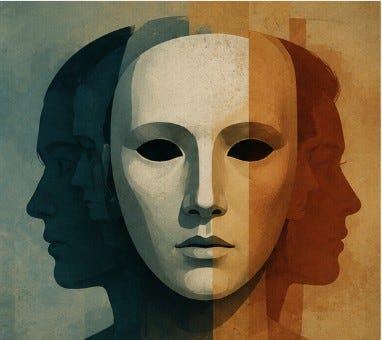
What we struggle to forgive is the suspicion that we are being shown a mask.
And in an age of algorithms, artificial intelligence and carefully managed personal brands, that feels like a distinction worth paying attention to.