


There’s been a lot of discussion recently about the so-called “Madman Theory” in foreign policy.
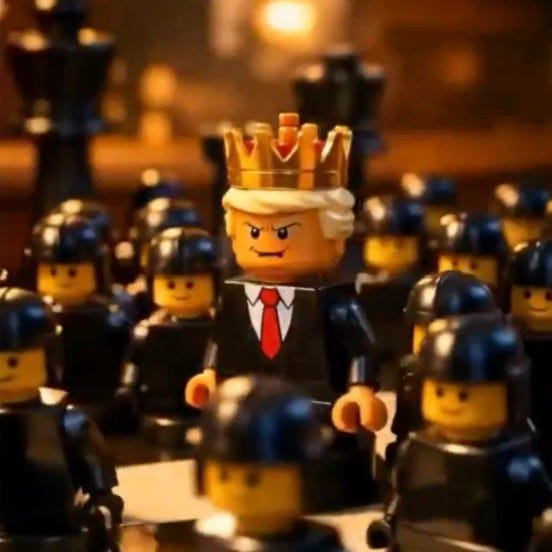
It’s a simple enough idea: if you appear unpredictable - even irrational - your adversaries might back down, simply because the risk of miscalculation feels too high.
It’s often traced back to Nixon, and more recently it’s been used, along with “3D chess” to describe the US’ foreign policy strategy.
But the more I’ve sat with it, the less convinced I am that this is the right way of understanding what’s going on.
Not because the behaviour in question isn’t erratic. It clearly is.
But because I think we’re misreading it.
The idea only really works if it’s occasional.
A tactic, by definition, disrupts expectations. It forces a recalculation. It introduces just enough uncertainty to shift the balance.
But if that uncertainty becomes constant - if it becomes the default - it stops being a signal. And becomes the pattern.
And once it’s the pattern, people stop asking whether it’s deliberate. Or tactical. Or strategic.
They start reaching for a simpler explanation. If someone appears irrational all the time, it may be less useful to assume that this is a carefully constructed performance and more useful to consider that it is simply how they are.
That may feel like an unsophisticated conclusion. But in practice, particularly in high-stakes environments, people don’t have the luxury of assuming hidden genius. They look for explanations that allow them to act with the greatest degree of certainty.
Which brings me to something I didn’t expect to find myself thinking about.
Over the past few weeks, I’ve found myself watching Iranian regime anti-US content.
Even writing that feels uncomfortable. The regime in Iran is not one I admire or align with. That hasn’t changed.
And yet some of the material coming up on my feed - particularly AI-generated satirical Lego clips has been strikingly sharp. And actually very funny.
Not because it reveals anything new, but because it draws together strands that have already been widely reported and presents them in a way that is difficult to ignore.
Questions of judgement. Of competence. Of suitability for office.
The sort of scrutiny that, in another context, we might recognise without hesitation.
What unsettled me wasn’t the content itself, but my reaction to it.
Despite years in diplomacy - of knowing, intellectually, that the world is complex - there is still a tendency to carry a simpler internal map.
A kind of goodie/baddie ledger.
A subconscious assumption that some actors sit broadly on the side of reason, of shared values, and others do not.
You don’t notice that map when it’s working. You notice it when it starts to break.
And that, I think, is where propaganda becomes genuinely effective.
Not when it fabricates a completely different reality, but when it takes something recognisable and reframes it just enough to create doubt.
At that point, the question is no longer simply whether something is true or false.
It becomes a question of credibility - of who is able to shape the narrative in a way that feels coherent.
This is where the idea of unpredictability becomes more complicated. Because signalling unpredictability doesn’t just affect the person you’re dealing with directly.
It affects everyone trying to interpret you. Allies. Observers. Domestic audiences. Anyone attempting to understand what you might do next.
In diplomacy, influence depends on legibility.
People are constantly trying to interpret the intentions of the actors around them - their incentives, their constraints, their likely next move. It’s how decisions get made and how risk is managed.
But when intent is unclear, people will automatically default to assuming its malign.
They assume risk.
So ambiguity doesn’t create neutral space. It creates a vacuum. And vacuums don’t stay empty for long.
They get filled by speculation, by inference, and often by the narratives of others.
Seen in that light, what I was watching wasn’t just effective messaging. It was an example of how quickly that vacuum can be occupied.
At the same time, I’ve found myself noticing a very different kind of presence in the same broader conversation.
Figures like Pope Francis speak into these moments in a way that feels markedly different.
There’s no sense of escalation, no attempt to dominate or outmanoeuvre.
If anything, the tone is quieter. And yet it still cuts through.
It would be easy to attribute that to moral authority or position. But I think there is something more practical at work.
He is understandable. His worldview is coherent. His priorities are consistent. His boundaries are clear.
You may not agree with him, but you are not left trying to work out what he believes or why he is speaking.
There is very little effort required to interpret his intent.
And in a noisy, uncertain environment, that clarity carries weight.
Set against that, unpredictability starts to look different.
Each statement requires interpretation. Attention shifts from what is being said to what might be meant. The audience is left trying to work out whether something is strategic, reactive, or simply unstructured.
Over time, that uncertainty doesn’t just create tension. It creates space for others to step in and define the narrative.
After twenty years of watching how influence works in practice, this is the part that feels most consistently true.
Unpredictability can create short-term leverage. But long term distrust.
Clarity builds something more durable. Influence ultimately depends on whether people feel able to interpret and relate to you with confidence.
So what does that mean in practice? Not just in a geopolitical sense, but in the much smaller environments most of us operate in.
Teams. Organisations. Conversations where influence is quieter, but no less important.
The temptation, particularly in uncertain moments, is to lean into ambiguity.
To keep people slightly off balance. To hold back just enough that your position can’t be easily pinned down.
It can feel like control. But I’m not sure it is. Because when people can’t work out what you mean, or where you stand, they don’t sit indefinitely in curiosity.
They resolve the ambiguity. They fill in the gaps. They seek clarity elsewhere.
And more often than not, they do so in a way that protects them, not you.
So the question I’ve been asking myself is a simple one:
How easy am I to understand?
Not in the sense of simplifying everything I think, but in the sense of whether the people around me can form a reasonably accurate picture of my intent.
Clarity isn’t just a communication choice. It’s a form of positioning.
And in a world that feels increasingly chaotic, it may be one of the few durable sources of influence we have left.