


My first posting as a UK diplomat was London. I was young, underpaid, and - like most junior diplomats - quietly thrilled by the whole thing. I lived carefully. I ate muesli and rice every day for two years. I counted what I spent. And periodically, when I’d saved enough, I’d make a pilgrimage to the bookshop.
The bookshop had a deal I loved: three books for the price of two. The challenge I set myself was not to confine myself to the genres I knew. That felt like cheating. The whole point was to pick something unfamiliar, something I wouldn’t normally reach for, and see what happened. It was my own small experiment in intellectual risk.
That’s how I found The Dice Man.
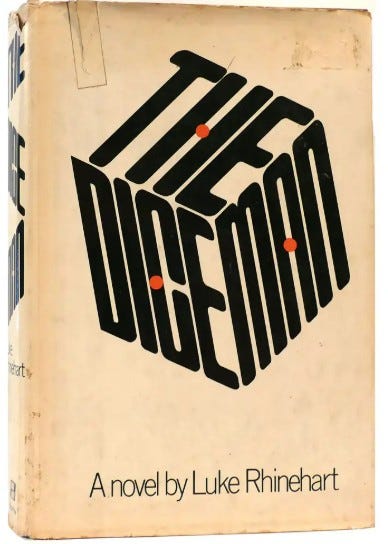
I picked it up because the premise was absurd and the cover was strange and I had no idea what I was getting into. I read it in a weekend. Then I read the rest of the series. Luke Rhinehart’s protagonist - a psychiatrist, bored and restless - begins making every decision in his life by rolling the dice. What to eat. Where to go. What to do to the people around him. The dice decide. He is, in his own telling, liberated.
He is not liberated. He is catastrophic.
I’ve been thinking about that book a lot lately. Not because I’m rereading it, but because I keep watching the news and seeing the same logic play out at a civilisational scale.
The rules-based international order - that slightly clunky phrase that diplomats reach for when they mean the system that stops powerful countries simply doing whatever they want - is under more pressure than at any point in my career. And what strikes me is not that people are breaking the rules. Rules have always been broken. What strikes me is that fewer and fewer people seem to feel the need to pretend they’re not.
The pretence mattered. That’s what I want to argue here. The pretence was not hypocrisy. It was load-bearing.
When Rhinehart’s psychiatrist starts rolling the dice, the first thing he loses is not his freedom. It’s his accountability. The dice did it. Not him. He becomes, in his own mind, a passenger in his own life - and that detachment is precisely what allows the harm to escalate. Because when you sever the link between decision and responsibility, you don’t eliminate consequences. You just export them onto everyone else.
This is the geopolitical condition we are now living in.
Some leaders have discovered that the old grammar of international relations, the language of norms and obligations and mutual constraint, can be abandoned without immediate penalty. You can invade a neighbour and call it a special operation. You can kidnap a head of state and call it justice. You can tear up a trade agreement and call it sovereignty. You can withdraw from an institution you helped build and call it common sense.
The dice rolled. Not us.
What’s missing from almost every public conversation about this is a serious attempt to explain what the rules were actually for. Not in the abstract. Not in the language of international law textbooks. But in the way that actually matters: what do rules do for the people who live inside them?
Here is what I learned as a diplomat, slowly and sometimes painfully: rules are not constraints on freedom. They are the infrastructure of predictability.
When two countries sign a treaty, they are not surrendering sovereignty. They are making a bet - that the future will be more navigable if both sides know what the other will do. Rules reduce the cost of every interaction. They mean you don’t have to assume the worst every time. They mean that a smaller country can sit across the table from a larger one and have some reasonable expectation that the conversation will be conducted in good faith.
Remove that, and you don’t get freedom. You get a world where every actor has to assume the worst of every other actor, all the time. You get a world that is exhausting and expensive and dangerous to navigate - especially if you are not the biggest player in the room.
The author knew this, even if his character didn’t. He admitted in interviews that his own dice-rolling was always “very limited.” He never gave the dice options that might hurt people he loved. He never risked his marriage. He drew lines. He understood, intuitively, that the experiment only worked as fiction because in reality, the people around you cannot opt out of your chaos.
That is the thing about unilateralism. It is always someone else’s problem. And we cannot opt out of the chaos.
The tragedy of this moment is not that the rules-based order is perfect. It isn’t. It was built by the powerful, often in the interests of the powerful, and it failed - sometimes catastrophically - to protect the people it was supposed to serve. Those are legitimate criticisms and they deserve serious engagement.
But the answer to an imperfect system of rules is not no rules. It is better rules. The answer to a rigged game is not to flip the table. It is to change who gets to sit at it.
What we are watching instead is something different: a kind of competitive nihilism, in which the dismantling of norms is treated as strength, and the defence of them as naivety. And the people who should be making the case for why this matters - the diplomats, the institutions, the political leaders - are either silent, or speaking in a language so technical and so bloodless that no one is listening.
Rhinehart’s dice man gripped me because he made chaos feel seductive. That’s the book’s genius. You understand the appeal. You feel the pull of it. And then, slowly, you watch what it costs.
We are in the slow part now.