


Every year Maria runs the same role play. She’s playing a patient in the middle of a psychotic episode. Waving a knife. Shouting that she has to defend everyone from the aliens.
The students aren’t given a brief. But they’re meant to find a way to talk her down. Perhaps: “No, no, no, these are the friendly ones. Look, they've brought cake.”
Instead they freeze, and then they diagnose her.
Every. Single. Year.
“They're incredibly clever,” she said. “But they just can't read the room. They can't see what a patient actually needs in the moment.”
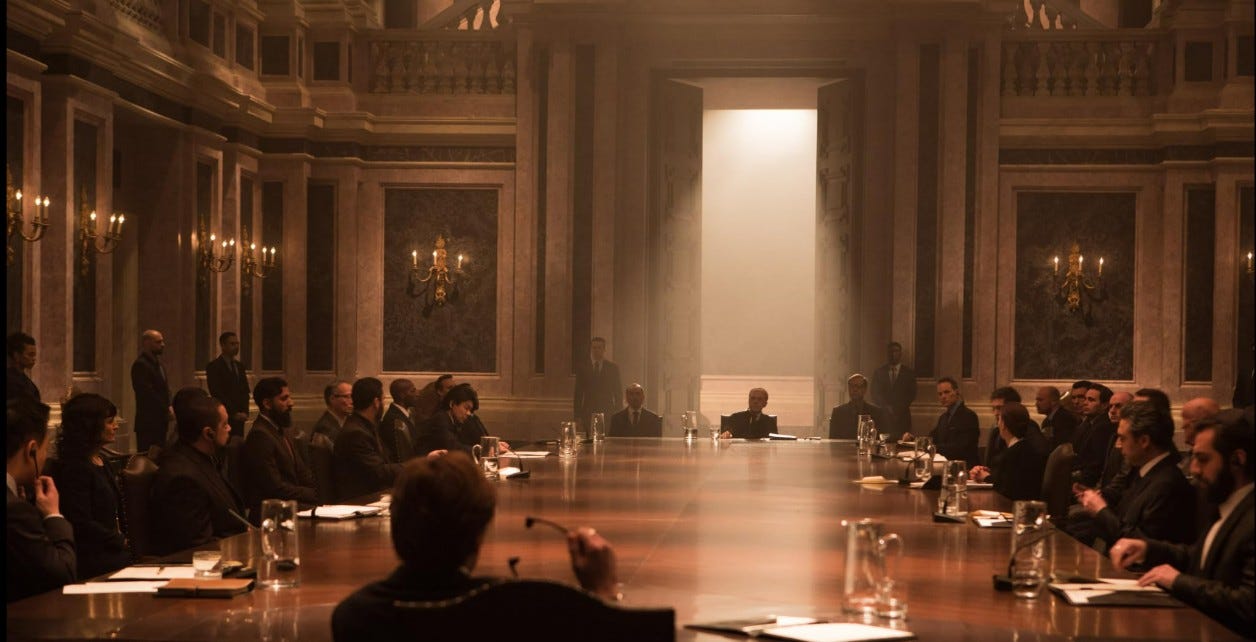
Maria’s a GP who mentors medical students at one of the best universities in the UK. Her job is to turn brilliant young academics into people who can sit with a patient on the worst day of their life and not make it worse.
We were in the middle of my own appointment when she told me this. I’d just given her the answer I always give when someone asks what I do.
That I work with individuals and teams, transferring what I learned from diplomacy into helping them lead, motivate, persuade and influence the people around them. “You know. How to read the room, and stuff like that.”
“Hmm,” she said. “Can that really be taught, though?”
I bridled. Of course it bloody can. How else do you think I learned how to do it?
Hidden inside the phrase “they can’t read the room” is an assumption we make all the time: that reading people is something you can either do or you can’t. Some people walk into a room and instantly get it. Others just…don’t.
If that were true, diplomacy would be an even weirder profession than it already is.
Diplomats are taught to read people.
The Foreign Office spends a surprising amount of time teaching us how to deal with other human beings.
We practised endlessly: actors, simulations, hostile interviews, difficult conversations, negotiations and crisis exercises. You’d be dropped into a situation, discover that the person opposite you was not behaving remotely as anticipated, and have to adapt. Then everyone would take you apart.
Sorry. I mean, give you constructive feedback.
My worst nightmare. But however brutal it was, it was the best way to learn.
Underpinning all that repetition was a simple thesis. Human beings under pressure rarely behave as we expect them to. And they do not all need the same thing from us.
Sometimes people need reassurance. Sometimes clarity. Sometimes challenge. Sometimes calm. Quite a lot of the time they just need you to stop talking.
I learned this while training for the Rapid Deployment Team (RDT) - diplomats sent out at a moment’s notice when a crisis is declared.
Our brief was that my roleplay partner and I were consular officers on a notorious party island. A young British woman had been found dead, and her brother was waiting in reception. He had not been told why.
We had two minutes to prepare before the actor playing her brother walked in.
And he was blind drunk.
He had been on a 24-hour bender and assumed we were police officers arresting him for being drunk and disorderly. Once we had persuaded him we were embassy staff, we had to tell him his sister was dead.
He started crying. Like properly sobbing. As he fell apart, so did our strategy.
As Brits, we’re not very good at other people crying.
We did not get top marks. The feedback, predictably, was brutal.
It was the best learning experience of my life.
The first person you have to read is yourself
When someone is upset, angry, frightened or simply difficult, we concentrate on their behaviour. But there are two nervous systems in that conversation. Theirs. And ours.
Our instinctive response is often designed less to meet their need than to relieve our own discomfort.
We fill the silence. We explain. We fix. We reassure. We defend ourselves. We produce more information. Anything, really, to make the encounter less uncomfortable.
In that role play, both of us started talking at once. Soothing, empathising, trying to make it better. I might have patted him on the knee. I definitely murmured platitudes. He came back with the obvious: how can you possibly know how I feel?
Fair. Of course I didn’t.
That’s why reading the room isn’t simply about noticing other people. It takes enough self-awareness to notice your own impulses without automatically acting on them.
Effective communication is not about relieving our discomfort. It is about turning down the volume on ourselves long enough to tune into the other person, and asking: what does this person need from me right now?
It isn’t mind-reading. It’s pattern recognition
There’s nothing mystical about people who read rooms well. They’ve watched hundreds of conversations go well and badly. They’ve learned that silence can mean reflection in one context and furious disagreement in another. Eventually, patterns emerge.
I think of reading the room as the intersection of pattern recognition and strategic empathy.
Pattern recognition says: “I’ve seen something like this before.”
Strategic empathy asks: “What is happening for this particular person, in this particular situation, right now?”
Without both, reading the room quickly becomes stereotyping it.
Strategic empathy isn’t manipulation. It’s trying to understand the world from where someone else is standing, so that you can communicate with them at all.
Experience gives you hypotheses. Attention tells you whether you are right.
What are you actually reading?
When I walk into a room now, there are a handful of things I notice.
1. Start with the energy
Before concentrating on individuals, notice the room as a whole. Is conversation flowing? Are faces flat? Are questions drying up? Does the room feel restless, defensive, curious, exhausted?
Energy is information, not a diagnosis. Low energy does not automatically mean people need cheering up. They might need purpose. High energy might need focusing.
My first deployment with the RDT was to Texas to find British students reported missing after Hurricane Katrina. We found them and got them into a hotel while we worked out what to do next.
At the check-in desk, I watched the group split in two. Some were chatting and went happily up to their rooms. A couple were completely flat. They did not want to be alone, so they stayed in reception.
2. Read the emotion beneath the behaviour
Anger, anxiety and exhaustion can all produce difficult behaviour, and they require very different responses.
Someone firing questions at you may be challenging your authority. Or they may be frightened. Someone who has gone quiet may have disengaged. Or they may simply be processing.
Those boys at the Dallas hotel check-in desk looked withdrawn. It transpired that they had spent several nights sheltering in the Superdome, listening to the sounds of distressed and displaced humans and trying to protect the girls they were with. They were not disengaged. They were traumatised and terrified of being alone.
I stayed with them through the night and, realising I was out of my depth, arranged counselling through the Red Cross.
The visible behaviour is only the first piece of information. The useful question is: what might be driving it? Curiosity is far more useful than judgement here.
3. Check the level of trust
One of the quickest ways to understand a room is to notice what people are willing to say.
Are they disagreeing openly? Are the answers strangely polished? Does everyone look at the most senior person before answering? Are people talking around the issue rather than naming it?
Silence and scripted answers can tell you as much as words do. When trust is low, pushing harder for honesty rarely produces it. You have to create enough psychological safety for people to risk telling you what they actually think.
4. Find the real influencer
The most powerful person in a room is not necessarily the most senior.
Who does everyone look at? Whose reaction are they checking? Who says very little but changes the direction of the conversation when they finally speak?
Every organisation has a formal architecture. And then it has a human architecture. Learning to see the second is one of the most useful things diplomacy taught me.
5. Listen for what’s missing
Sometimes the most important information in a room is the thing nobody is saying.
Which question keeps going unanswered? Where does the conversation suddenly become vague? What does everyone appear to know but nobody wants to name?
Often, that omission is where the real conversation begins. Try asking: “There is one thing we haven’t talked about yet. Why is that?”
And then comes the bit people forget: adapt
Reading the room is not the skill. Reading the room and then changing what you do because of what you noticed is the skill.
That might mean slowing down. Being more direct. Giving people more information, or less. Asking a question instead of making your argument. Letting an uncomfortable silence sit there. Challenging the thing everyone else is politely ignoring.
Or abandoning the beautifully prepared thing you intended to say, because it is clearly not what this room needs.
My colleague and I had spent two minutes preparing a strategy for our role play. It was a perfectly good strategy for a man who was sober and perhaps already suspected what we were about to tell him.
But that was not the man who walked through the door.
We should’ve abandoned the script. Slowed everything down. Told him clearly what had happened. Then stop talking to give him time to absorb it.
Adapting does not mean changing what you believe or disguising the message. It means changing the route by which it can be heard.
The message you want to deliver matters. So does the human being receiving it.
You get better at humans by spending time with humans
Reading the room can be trained but only through practice.
You get better by paying attention. By getting your interpretation wrong and noticing why. By sitting in uncomfortable rooms, having difficult conversations and discovering that the response you created was not the response you intended.
Then doing it again. More rooms. More humans. Those are the reps.
If you want somewhere to start this week, pick one:
- Enter a meeting intending to observe for the first five minutes before you say anything.
- Before a decision gets made, guess who will really shape it. Then watch.
- Notice your impulse to fill a silence, and don’t.
- After a difficult interaction, write down what you thought the person needed, and what they may actually have needed.
Reading the room isn’t about becoming the cleverest person in it. It is about being attentive enough to realise the room is giving you information all the time.
The question is whether you’re paying attention.
Your essays are underestimated. I hope you keep writing and sharing, thanks!🫶🏻
I loved this, specifically because it reminds us that these skills are teachable! I’ve been a bit of a bomb-sniffing dog since childhood (out of necessity) and it’s always been a highly praised skill as a leader, consensus-builder, and negotiator - but I’ve sometimes struggled with how to teach these skills to others in a “healthy” way that isn’t born from looking for danger ☺️ Thank you for this!