


The Ambassador’s weekly policy meeting was my idea of torture.
He would summon the great and the good - and me - without telling us what he wanted to discuss. Then, once we were gathered around the table, he would announce the subject and ask what we thought.
Everyone else appeared able to produce intelligent, beautifully evidenced insights on command. I was the most junior person in the room and pregnant with my second child. I’d returned to Cairo six months previously after being evacuated, and had been pulled off my Arabic language training early to fill the vacancy. There had been no handover. In that first year in the job I was enveloped in a permanent fog of underpreparedness and insecurity. At these meetings in particular my principal priority was usually to stifle my panic long enough to assemble a coherent sentence.
It didn’t help that a senior colleague had a foghorn voice and an opinion on everything.
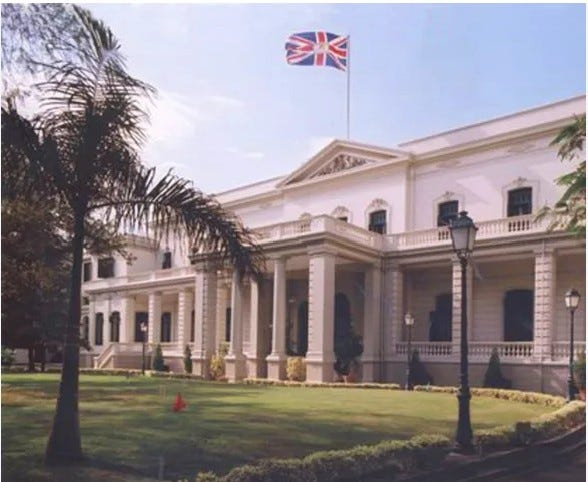
British Embassy, Cairo.
He’d been in Cairo longer than I had and had established himself as the embassy’s most confident interpreter of the post-revolutionary political landscape. The Ambassador relied on him heavily.
The Ambassador had arrived in a comparatively predictable political environment. The first revolution had replaced it with one in which almost everything was contested and nobody was entirely sure what might happen next.
My colleague had knowledge the Ambassador needed. He had also become extremely close to him and guarded that relationship jealously. He was invariably the first to brief him, the first to answer in meetings and, unless you were extraordinarily quick off the mark, frequently the first to answer on behalf of everybody else.
One week, I managed to report that some of my contacts were talking about the possibility of a second revolution.
“It’ll never happen,” he said, talking straight over me.
Then one of the most senior colleagues around the table intervened.
“Let her finish. We’ve been picking up the same noises.”
I’d love to tell you that this was my Aretha Franklin moment. You know the one: finally, FINALLY, you get heard, and somewhere in the background Aretha starts belting out R.E.S.P.E.C.T.
But the Ambassador did not immediately sit up, renounce everything he had previously believed and announce that I’d been right all along.
I don’t remember him reacting at all. Or anyone really.
But I did.
That intervention gave me the confidence to contradict the foghorn more often. It also confirmed something I had gradually begun to understand: the quality of my argument was only one part of whether it would be heard.
I had assumed that the answer was to become better at the meeting: quicker, louder and more confident.
But the meeting was designed around my colleague’s strengths. He controlled the pace, filled every silence and could smother an alternative argument under the sheer quantity of words used to oppose it. I could have spent years learning to talk faster and longer. I still wouldn’t have got much air time.
I needed better information, credible allies and other routes through which my judgement could reach the Ambassador.
The decision-maker is only the beginning
On paper, the Ambassador was the decision-maker. If I wanted to influence him, the obvious answer was to get into the room, present good information and make a persuasive case.
But that description left out almost everything that determined how he received the information.
Who had briefed him first? Whose judgement did he trust? Who had access to him when the rest of us weren’t there? Who possessed expertise he lacked? Whose agreement made an unfamiliar view feel credible? Who could interrupt, reinterpret or simply occupy all the available oxygen before another person had finished speaking?
My colleague’s influence did not come only from his formal position. It came from a particularly powerful combination of expertise, access, confidence and timing. He didn’t merely give the Ambassador an opinion. He frequently supplied the frame through which the Ambassador understood the issue.
By the time the rest of us entered the room, much of the interpretative work had already been done.
You will almost certainly have experienced a version of this. Perhaps without even realising. Or perhaps you’ve caught yourself thinking, there’s something else going on here; something under the surface that I can’t quite figure out.
We tend to take formal decision-making at face value. If the board is deciding, we concentrate on the board meeting. If the boss has the final say, we concentrate on persuading the boss. We improve the slide deck, rehearse the difficult answer and make sure we can defend the numbers.
All of that may be necessary. But the people in the room arrive with views already shaped by other conversations, loyalties, anxieties, previous experience and people they trust.
The meeting may be where the decision is recorded. It is not necessarily where the decision is made.
Stop attacking the strongest point
It was fairly obvious to me within a couple of weeks of starting my job and attending those policy meetings that I was not going to beat my colleague in a direct contest.
He was more senior, had better access to the Ambassador and could talk for far longer than anyone could reasonably remain interested. He had developed an effective form of filibustering: boring everyone into silence until we had either forgotten what we wanted to say or decided it wasn’t worth prolonging the meeting to say it.
Confronting him every time we disagreed would have been exhausting. It was also unlikely to work.
So I had decided on a different approach.
I built a closer relationship with the Ambassador’s PA and Residence Manager, both of whom he trusted. They would discreetly notify me when he had space in his diary or needed someone to accompany him to a meeting: small openings in which I could speak to him directly, without my colleague appearing at his elbow and answering for both of us.
I also paid attention to the colleagues whose judgement the Ambassador respected and worked out which of them had their own doubts about my colleague’s perpetual certainty. In particular, I developed relationships with two of the embassy’s most senior and experienced colleagues. Both had independent sources of information and enough standing to challenge him. Neither was easily dazzled by absolute confidence.
Most importantly, I kept building my own network outside the embassy.
That gave me more than a competing opinion. It gave me information I could test against what other people were hearing. When my senior colleague said that his sources were picking up the same noises about another revolution, he wasn’t merely being kind to the nervous junior colleague. We had been comparing notes for weeks. I already knew his information backed mine. Now the Ambassador was hearing it from someone whose judgement he implicitly trusted.
I hadn’t recruited an anti-foghorn faction. Nor had I replaced one monopoly on the Ambassador’s thinking with another. I’d begun to create alternative routes through which information and judgement could reach the person making the decision.
That is an important distinction. Influence is not always about persuading somebody to agree with you. Sometimes it is about making it possible and creating space for a different view to be heard at all.
Know the enemy and know yourself
Sun Tzu, The Art of War
Your colleagues are not literally your enemy. Well, not all the time. But the principle is useful: knowing what you want to achieve is only part of the preparation. You also need to understand the people involved, what matters to them and how they are likely to respond.
The military would regard this as basic preparation.
My military training covered battlefield tactics and creating the space to think tactically under pressure. My Intelligence Corps specialisms covered planning ahead.
Before a commander moved troops, the intelligence team tried to build the most accurate picture possible: where the enemy was, what it was capable of, how it had behaved before, the terrain it occupied and, just as importantly, what we still did not know.
That intelligence shaped the route, the timing, the resources and the support the commander might need. You would not send people forward and only afterwards start investigating what they were advancing towards.
At work, we routinely do a version of exactly that. We devote enormous energy to our own contribution and remarkably little to understanding the human terrain into which we are about to launch it.
The standard advice is to show initiative. Take ownership. Put your hand up. Make things happen.
But initiative is not automatically rewarded. Recent research into employees who proactively changed aspects of their work found that the relationship with wellbeing depended on their political skill: their ability to understand people at work and influence them effectively. Across two studies involving more than 550 full-time US employees, those with stronger political skill who reshaped their jobs reported less frustration, exhaustion and strain, and greater satisfaction. Those with weaker political skill showed the reverse pattern, often leading to burnout.
These were observational studies, so they do not establish cause and effect. Nor is reshaping your job the same as every kind of initiative. But the findings suggest that advice to simply put yourself forward leaves out something important: whether you can secure the cooperation your new responsibilities require.
You volunteer to fix a problem but fail to involve the person whose team will have to implement your solution. You take on responsibility without securing access to the information or resources you need. You persuade the person with the title and overlook the person whose judgement they rely on.
You’re now doing more work, carrying more risk and irritating people whose support you didn’t realise you needed.
Imagine being told to take an enemy position on the other side of a valley. Before moving, you would want to know where the enemy was, what they could see and which routes offered cover. If your plan depended on support from another unit, you would need to establish what they could provide and when. You wouldn’t set off and assume somebody would arrange it once you were halfway across.
The workplace equivalent is volunteering your team to deliver a project before checking what they are already working on, what would have to give and who else would be affected. Your enthusiasm doesn’t create extra capacity or secure another team’s cooperation. That takes conversations, agreements and preparation.
Draw what you cannot see
Most of us carry some version of an influence map in our heads. Unfortunately, the version in our heads tends to contain the people we know best and like working with, the reporting lines we can see and a number of assumptions we have forgotten are assumptions.
Drawing it forces you to be more precise.
Start with one objective. Not improve my influence or build my network, but the actual outcome you are trying to secure: approval for a proposal, resources for a project, support for a promotion, cooperation from another team or a change in policy.
Put the formal decision-maker on the page. Then ask who surrounds that decision.
For example, suppose you need board approval for a proposal. The board has the final say, but the proposal may depend on the Finance Director’s assessment, the Operations Director’s willingness to provide staff and the confidence of a colleague the chair regularly consults.
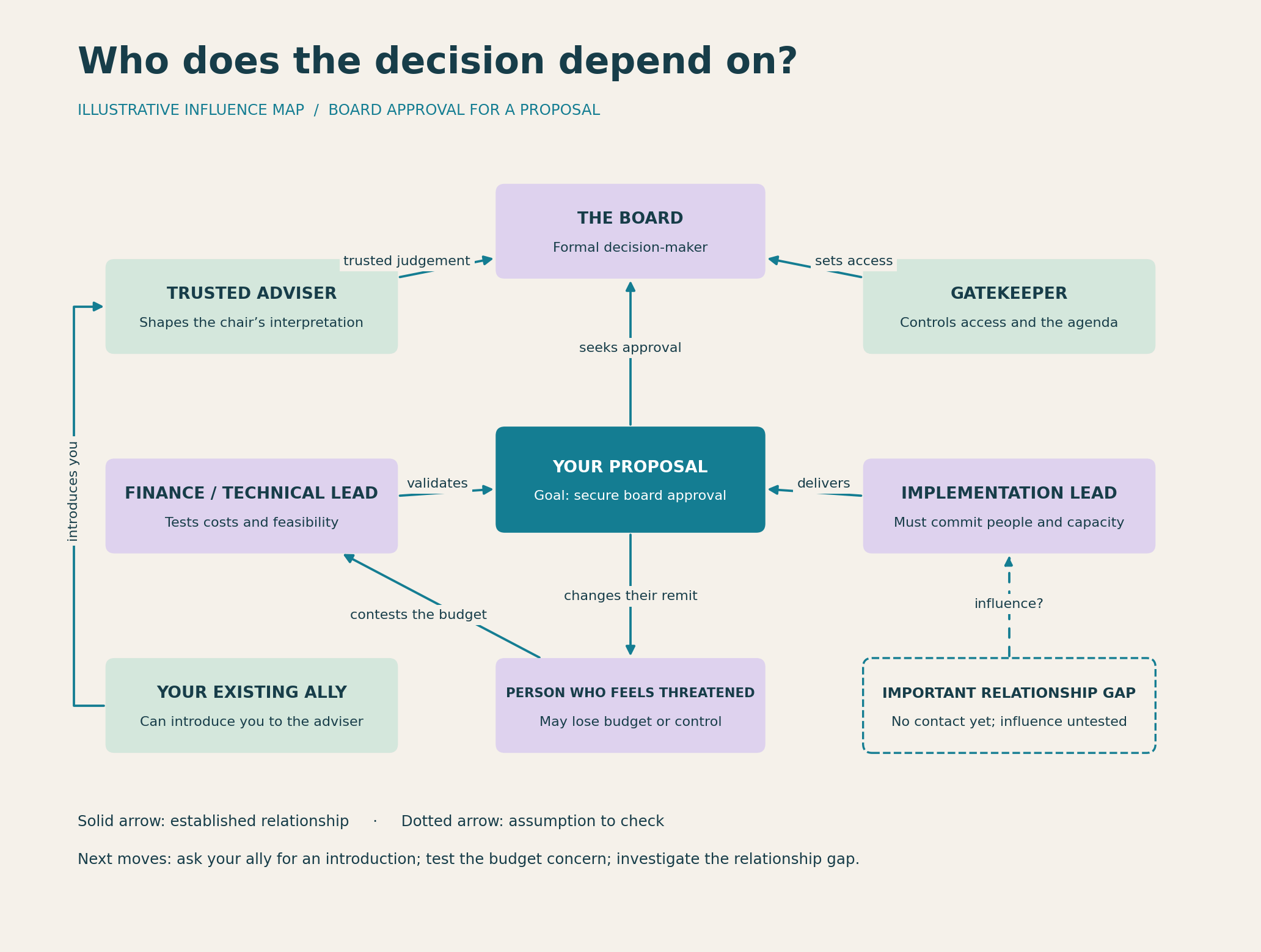
An illustrative map, not a template for every organisation. Solid arrows show relationships you have established; the dotted arrow marks a possible influence you still need to check.
Who has the decision-maker’s trust? Who speaks to them before everyone else? Who controls access or information? Who possesses expertise they rely on? Who will have to implement the decision? Who might feel threatened by it? Whose support would make your proposal seem more credible? Who can block it without openly opposing it?
Then draw the relationships between them. Who listens to whom? Where are the strong alliances? Where is there friction? Who can reach someone you cannot? Who sees the situation from a different angle? Who is conspicuously absent from your own network?
Finally, separate what you know from what you are assuming.
An influence map is not intelligence merely because it contains lots of names and arrows. Intelligence has to be gathered and tested. Ask questions. Listen. Notice who is consulted, copied in or deferred to. Compare what you are hearing from different sources. Update the map when the objective or the people change.
The gaps are often its most useful feature. They tell you what you need to find out, which relationships you may need to build and where your current plan depends mainly on hope.
Prepare for the decision, not merely the meeting
Understanding this map changed the way I approached those weekly meetings.
I still needed credible information. I still needed to express it clearly. Occasionally I still needed a senior colleague to ask the human foghorn to let me finish.
But I no longer believed that the entire contest began when we sat down around the table. My ability to contribute in the room rested on work done outside it – before and after: the external relationships that produced better information, the internal relationships that helped me test it, and the people whose independent judgement could prevent one confident voice from becoming the only version the Ambassador heard.
That is why influence mapping is not an exercise in identifying important people and attempting to ingratiate yourself with them. It is a way of understanding what an outcome actually depends upon.
By all means, prepare what you are going to say in the meeting.
But don’t mistake the meeting for the decision.
Great read, very helpful for the non diplomat! I’m in the sciences and we rarely think about these dynamics, but of course, they are just as present at the end of the day.
Being heard isn’t just about having the strongest argument. It’s also about understanding the relationships and trust shaping a decision. How often do we prepare what to say without considering who needs to hear it first?